
Every once in a while, you'll see one in an antique store or on eBay: a preserved hoof from long ago. A favorite hunter or cavalry charger lives on because one of his hooves was preserved as a trophy.
The National Army Museum in London, England has their collection on display now as part of their "War Horse: Fact & Fiction" exhibition.
The two primary ones used in curator Pip Dodd's video lecture are excellent contrasts in hoof form and shoe fit.
 |
| Would you care for a cordial? Rowland Ward combined his big game expertise and his hoof trophy specialty in this mini-bar created from an African elephant's foot. |
Now, here's my question: Did they only preserve one hoof? Would they have just tossed out the others? What if it was a really famous horse?
More recently, I've come to question the preparation of the hooves themselves. If British army regulations required hooves to be burned with identification numerals, and if the farriers were required to retrieve the numbered hooves after battle, why do we seldom see hooves with numbers burned into the wall? Were they sanded down until the numbers disappeared?
 |
| Were some preserved hooves merely vehicles to display horseshoes? This heart bar shoe is almost 100 years old; it lives in the beautiful tack room at the Badminton House stables in England. The hoof doesn't look particularly like it suffered badly from laminitis, although the beloved horse who wore the shoe apparently did. There may have been different priorities for hoof trophies. |
Perhaps the answer lies here, in this blog's story from December 2011 about the dreaded farrier ax:
"The Household Cavalry still burns numbers into three out of four of each horse's hooves. The near hind bears the horse's army number, the near fore his squadron number and the off fore has the regiment's initials."
 While some people are repulsed at the site of hoof trophies, others are intrigued. First of all, they were preserved in an era where a rider may not have had the option of a photo or even a drawing to remember a favorite horse.
But what intrigues Hoofcare + Lameness readers is that the final product of a trophy doesn't seem to have much--if anything--to do with how the horse was shod. The shoes attached to the trophies seem to have been crafted by silversmiths, not farriers. Their fit is questionable and some even lack nails, although the clinches can still be seen in the hoof wall.
Much more information on hoof preservation--not just of horse hooves but safari trophies and game--was detailed in the 1883 book, Observations on the Preservation of Hoofs and Designing of Hoof Trophies, by Rowland Ward of London and Nairobi.
Ward, who had aspired to become a sculptor in his youth, was quite a prolific trophy artist; he offered more than 50 designs for hooves in his shop. His designs were patented and his clients included the Duke of Edinburgh.
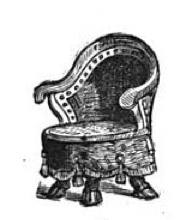 |
| A Rowland Wolf hoof chair |
The book details an important part of hoof trophy-making that has always challenged me. He states that the shoe worn by the horse is useless when making a trophy because the foot will change shape during the preservation process, and that crafting a suitable shoe for the trophy is part of the trophy-builder's task--and that a farrier is not the craftsman to be hired to build the shoe.
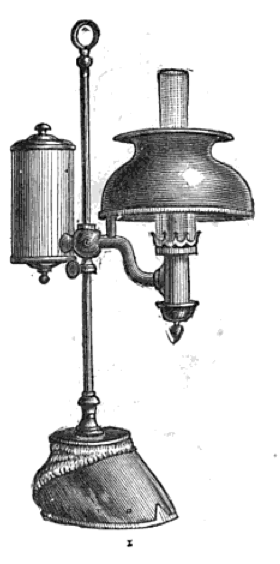 |
| A Rowland Wolf hoof lamp |
He also mentions that part of the skill of the trophy-builder was in repairing the frogs of horses that had been affected by thrush, which apparently was prevalent in the hooves sent to him for preservation. Unfortunately, he doesn't go into much detail about how he did this.
Ward employed an assistant who worked on nothing but horse hoof trophies for more than 20 years.
Rowland Ward died in 1912 but the Rowland Ward business is still in business in Johannesburg, South Africa. For some time, there was a US branch of the business, most recently headquartered in Dallas. The US office closed in 2009.
The company's web site is a mecca for what is left of the big-game hunters, and those who study the history of hunting and taxidermy, and the skillful arts of Rowland Ward.
 |
| A Rowland Wolf hoof scale |
Today we have plastination and freeze-drying to preserve horse hooves, but the reason behind the preservation tends to be for educational purposes, rather than to preserve a memory or create a memorial. We demand lifelike detail, rather than artistic expression.
For Rowland Ward, a hoof from a dead horse was a blank canvas for artistic expression and his imagination ran as wild as the big game that arrived on his doorstep to be preserved, hooves and all.
To learn more:
National Army Museum (UK) hoof trophy feature
Sports Illustrated (1959): A Man Who Knows How To Stuff An Elephant
Farrier's Ax: A Museum Restores a Gruesome Tool of Mercy Designed to End the War for Horses
Why Is That Guy Following Prince William and Kate Middleton Carrying a Big Shiny Ax? Because He's the Farrier, That's Why!
A collection of hoof trophies, including at least one by Rowland Ward, in the collection of the Canadian Anglo-Boer War Museum

Follow Hoofcare + Lameness on Twitter: @HoofcareJournal
Read this blog's headlines on the Hoofcare + Lameness Facebook Page
Disclosure of Material Connection: I have not received any direct compensation for writing this post. I have no material connection to the brands, products, or services that I have mentioned, other than Hoofcare Publishing. I am disclosing this in accordance with the Federal Trade Commission’s 16 CFR, Part 255: Guides Concerning the Use of Endorsements and Testimonials in Advertising.
